
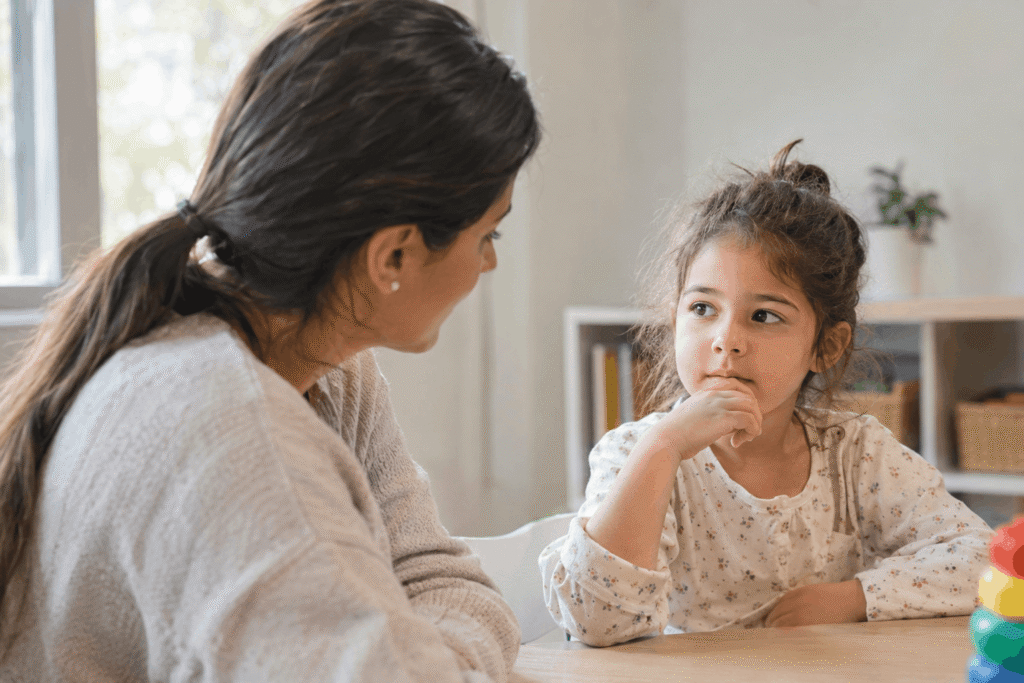
An occupational therapy perspective on the questions parents ask most about talking, understanding, and connecting with their child.
Why Does My Child Suddenly Go Quiet Mid-Sentence?
Your child starts a sentence with total confidence, then stalls halfway through — searching, stuck, sometimes giving up entirely. From an OT perspective, this often isn’t really about the word itself. It’s about what’s happening in the body and nervous system at that exact moment.
Talking is a motor act, just like tying shoes or catching a ball — it takes planning, timing, and regulation to pull off smoothly. When a child is dysregulated, overstimulated, or their system is working overtime on something else, speech is often one of the first things that goes offline, because it’s one of the most demanding things the body does.
A few different things can be going on
- Overload freeze — too much sensory or emotional input at once, and talking is the first casualty
- Motor planning breakdown — the message is there, but the sequence of movements to get it out isn’t cooperating in that moment
- A genuine speech block — common with early stuttering, where breath and articulation momentarily don’t sync
What helps in the moment
- Give their nervous system time to settle before expecting words — a pause, not pressure
- Say “take your time” instead of “what’s the word?” — one lowers demand, the other raises it
- Offer a way to communicate that doesn’t need speech right then — pointing, showing you, a gesture
- Notice the pattern — tired, excited, crowded room, rushed transition — the environment usually tells you more than the freeze itself
Is It a Speech Delay or a Language Delay?
Parents use these two words interchangeably, but from where I sit, the more useful question is: how is this affecting what your child can actually do in their day? Whether it’s speech or language, the real measure is participation — can they get their needs met, join in play, follow along at school.
That said, the distinction still matters for how we build a plan:
- Speech is about the physical production of sounds — the oral-motor coordination of lips, tongue, jaw, and breath working together. A child with a speech delay might have plenty to say but be hard to understand.
- Language is the content — vocabulary, sentence structure, understanding, and using words meaningfully. A child with a language delay might be clear but use very few words or short sentences.
Why OT looks underneath both
A child can have one without the other, or both. In OT, we’re often looking underneath both of these at the motor planning and regulation piece — a child who struggles to sequence movements in general (getting dressed, following a multi-step task) may show the same difficulty sequencing the movements needed for clear speech. It’s often not two separate problems; it’s one underlying pattern showing up in different parts of the day.
If you’re not sure which you’re seeing, that’s exactly what a full evaluation — looking at the whole child, not just the words — is for.
My Child Understands Everything but Says So Little
This is one of the patterns that brings families to me most often: your child follows directions, laughs at the right moment, clearly takes in everything around them — but their own output lags far behind.
I think about this the same way I think about skill versus performance in any other area. Your child may have the understanding — the skill is there — but producing speech requires motor planning, regulation, and coordination that take longer to come online. A child can be absorbing language for a long time before their body is ready to produce it back.
A few things that influence this gap
- How regulated they are — a dysregulated body has less capacity left over for the motor demands of speaking
- How much motor planning a longer sentence or a harder word requires
- Whether they have another reliable way to communicate in the meantime — gesture, pointing, pictures, sign — and whether that’s being supported or discouraged
What tends to help
- Model instead of quiz — narrate what you’re doing rather than constantly testing them with “what’s this?”
- Build on whatever they can already do — if they point or gesture, honor that as real communication while gently expanding it
- Create motivation, not pressure — pause expectantly, hold something desirable just out of reach
- Support the whole system — enough sleep, movement, and regulation often does more for output than direct drilling
A wide gap between understanding and talking usually isn’t a stalled child. It’s a child building the foundation for something that hasn’t caught up yet.
Why Does My Child Talk at Home but Go Silent at School?
This is a regulation story as much as it is a communication story. A child who’s chatty and confident at home going completely silent at school or around unfamiliar people usually isn’t choosing silence — their nervous system is, in that environment, pulling resources away from speech to manage everything else it’s dealing with.
Every environment has a different sensory and social load. Home is familiar, predictable, low-demand. School is louder, busier, more watched, and asks a child to regulate all day long. When regulation resources are already stretched thin managing the environment, speech — one of the most complex, demanding things the body does — is often what drops away first.
Things that tend to raise the demand
- Being asked directly to perform speech (“say hi!”)
- Being watched while trying to talk
- Repeated, well-meaning pressure to “just try”
What tends to help
- Lower the total demand before expecting speech — let them settle into the space first, without a talking requirement attached
- Let non-verbal ways of participating count — nodding, pointing, using a trusted peer — while comfort builds
- Build tolerance gradually, in small predictable steps, rather than expecting a sudden switch
- Keep expectations calm and consistent across school and home, rather than repeatedly testing whether today’s the day
This isn’t about forcing words out. It’s about helping the nervous system feel safe enough in that environment that speech becomes possible again.